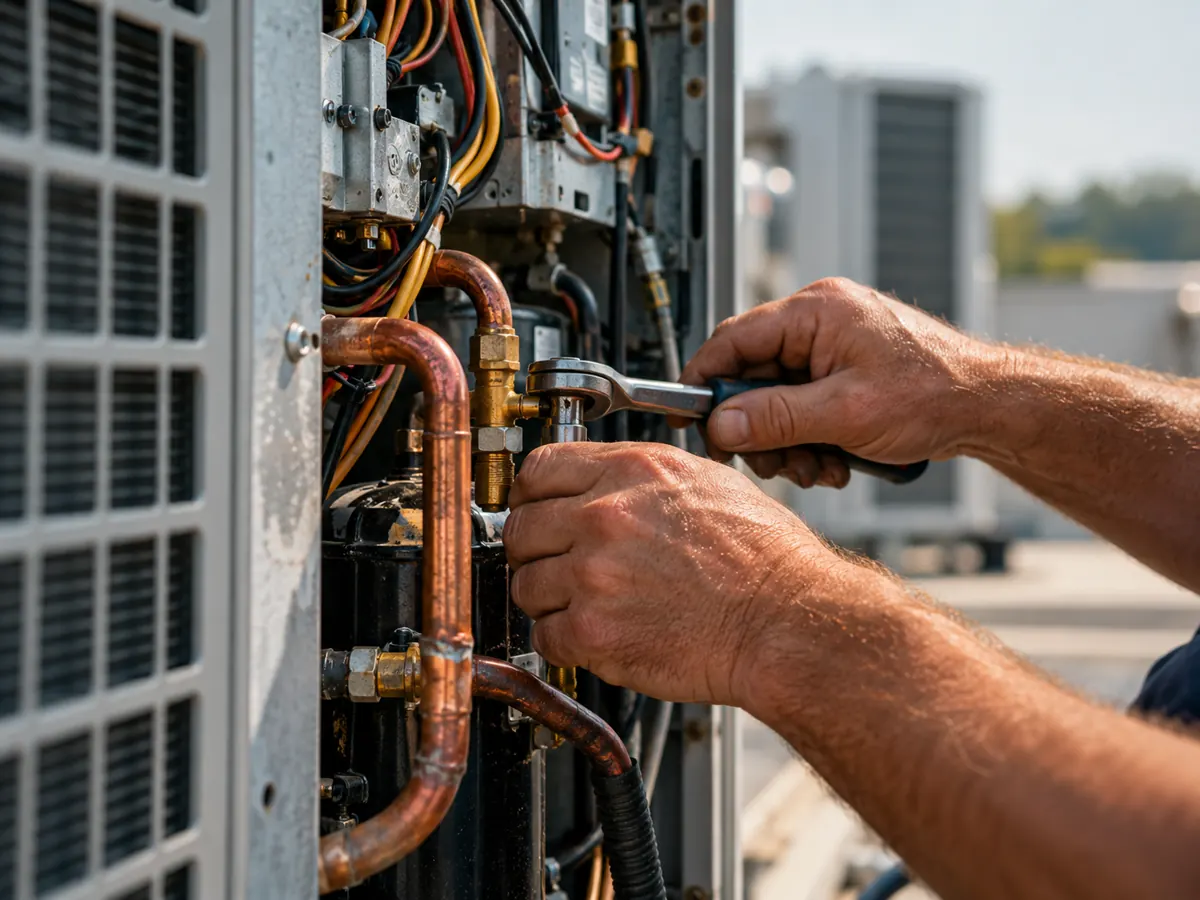
Each noise from an AC in Memphis, TN points to a different cause, whether it is banging, rattling, squealing, buzzing, clicking or humming. The guide below helps you describe the sound; after that, use Call Now for a diagnosis and you will be connected with an independent HVAC contractor serving 59 ZIP codes around Memphis.
What each sound usually means
| Sound | Likely cause | Urgency |
|---|---|---|
| Grinding | Failing bearings or a compressor problem | Turn off and call |
| Squealing or screeching | Worn blower or fan motor bearings or a slipping belt | Call soon |
| Clicking at startup | Contactor or relay problem | Call soon |
| Hissing or bubbling | Refrigerant leak | Call soon |
| Rattling | Loose panel, debris in the unit or a loose fan blade | Check and call |
| Humming without starting | Failed capacitor or stuck motor | Turn off and call |
| Buzzing | Loose electrical connection or failing contactor | Call soon |
| Banging or clanking | Loose or broken internal part | Turn off and call |
Safe checks before you call
- Check that the filter is clean and the registers are open
- Record a short video or audio clip for the technician
- Look for loose panels or debris around the outdoor unit
- Note when the sound happens: at startup, during running or at shutdown
Why noise should not be ignored
Strange noises often come before a failure. A weak capacitor can strain the compressor, a bad bearing can seize the motor and a loose part can damage the coil. Early service is usually cheaper than a failure on the hottest day.
A checklist for this week
- Clear the outdoor unit of debris
- Inspect the drain line outlet and the area around the air handler for water
- Book a tune-up if it has been more than a year
- Test the thermostat and schedule
- Write down any noises or smells
- Check supply and return registers
Ducts, airflow and comfort
Comfort depends on airflow as much as on cooling capacity. Leaky ducts, undersized returns and blocked registers cause hot rooms even when the system is sound. A technician who measures static pressure and airflow, not just refrigerant pressures, will find these problems.
Myths and facts
- Myth: maintenance is optional. Fact: dirty coils and weak capacitors cause many summer failures.
- Myth: a bigger AC is always better. Fact: oversizing causes short cycling and humidity problems.
- Myth: set the thermostat very low to cool faster. Fact: the AC cools at a steady rate and just runs longer.
- Myth: refrigerant is used up. Fact: low refrigerant means a leak.
- Myth: closing vents saves energy. Fact: it raises duct pressure and can cause leaks and noise.
HVAC terms explained
- Static pressure: a measure of airflow resistance in the ducts
- Contactor: the switch that sends power to the outdoor unit
- Capacitor: stores charge to start and run the compressor and fan motors
- Evaporator coil: the indoor coil where refrigerant absorbs heat from the air
- EPA Section 608: the certification required to handle refrigerants
- Superheat and subcooling: readings that show whether the refrigerant charge is correct
- Condenser coil: the outdoor coil where heat is released
- Condensate drain: the line that carries moisture out of the house
What shapes the written scope
Two AC calls that sound alike can be very different jobs. The written scope should say what the technician found and which of these factors applied.
Have the provider show the diagnostic and the repair as separate items, and list any parts, labor or follow-up that are left out.
- Whether the ductwork, return air or thermostat contributes to the problem
- The age, tonnage and refrigerant type of the system
- Access to the air handler in the attic or closet and to the outdoor unit
- Whether the fault is an electrical part, an airflow problem, a refrigerant leak or a drainage problem
- Warranty status of the parts and whether the equipment is registered with the manufacturer
Safety and rules to know
Three hazards share one machine in an air conditioner: high-voltage electricity, pressurized refrigerant and moving parts. Opening electrical panels, bridging contactors and adding refrigerant are not jobs for homeowners, and capacitors can keep a charge after the power is off.
In the United States, anyone who buys or handles refrigerant must be certified under EPA Section 608, and refrigerant must be recovered and not vented. Ask the technician for their certification and check the contractor's licence with Tennessee Board for Licensing Contractors (HVAC classifications).
Questions to ask before approving a repair
- Will you give me the findings and the scope in writing before work starts?
- What are my options: repair now, repair and monitor, or replace?
- What does the repair warranty cover and for how long?
- How old is the system and which refrigerant does it use?
- What failed, how did you confirm it and can you show me the part or the reading?
Prepare your Memphis home before the technician arrives
- Check that the outdoor disconnect and the breaker are on, but do not open electrical panels
- Write down the sounds, smells, leaks or ice you have noticed, and when
- Set the thermostat to cool and note what it shows and what the house temperature is
- Clear weeds, leaves and debris from around the outdoor unit
- Replace or check the filter, and clear furniture from the return grille and the air handler
When to call a professional
Several situations call for a contractor: a system that will not start, ice or water, a problem that returns after your own checks, grinding or banging noises, or anyone in the house who is vulnerable to heat or cold. Use Call Now at the top of the page, describe what the system is doing, and you will reach an independent HVAC contractor who covers your ZIP code, confirms the address and diagnoses the system in person.
What this means for a home in Memphis
Hot, humid Mid-South summers with heat indexes often above 100 degrees; winters can bring ice storms. Humidity drives condensate drain clogs, sweating ducts, and mold in air handlers.
Memphis Light, Gas and Water (MLGW) is the local utility. Older homes in Midtown, Cooper-Young, Binghampton, and Whitehaven; newer homes in Cordova, Collierville, Germantown, and Bartlett. Bring these local details into any comparison of advice, and ask each technician how they apply to your system and your house.
Getting help in Memphis and nearby cities
Independent HVAC contractors covering 59 ZIP codes in Memphis, Tennessee are reached through Air Conditioning Repair Memphis: 37501, 37544, 38101, 38103, 38104, 38105, 38106, 38107, 38108, 38109. Providers who serve Ellendale, Germantown, Cordova and Collierville can also receive requests. Each address is confirmed separately.
Start with Call Now at the top of the page and say what you have found. The contractor checks your address, looks over the system and gives you the scope in writing.
Keep reading
Related pages for Memphis homeowners: Frozen AC Coil: Why It Happens and What to Do; SEER2 Explained for Memphis Homeowners; How to Lower Cooling Bills; Summer HVAC Checklist for Memphis. For the area list, see the service areas page.
Common questions about AC making noise: what each sound means
Why is my AC humming but not starting?
A failed capacitor or a stuck motor is often the cause, so switch it off and call for service.
Is a clicking sound normal?
One click when the unit starts is normal; clicking over and over without starting is a problem.
What does a hissing sound mean?
That can point to a refrigerant leak.
Can I fix a rattling unit myself?
If it is safe with the power off, tighten the panels; if not, call.
Why does my AC squeal?
Bearings that are worn, or a belt, are likely causes; get it checked.
Should I turn off a noisy AC?
Switch the unit off when you hear grinding, banging or hissing.